


Creative Agency Trend Report 2026
What’s actually changing, what isn’t, and why most brands are still getting it wrong.
Most companies don’t have a marketing problem
They have a clarity problem
Key Marketing Stats for 2026
Marketing is not slowing down. It is becoming more expensive, more saturated, and less efficient.
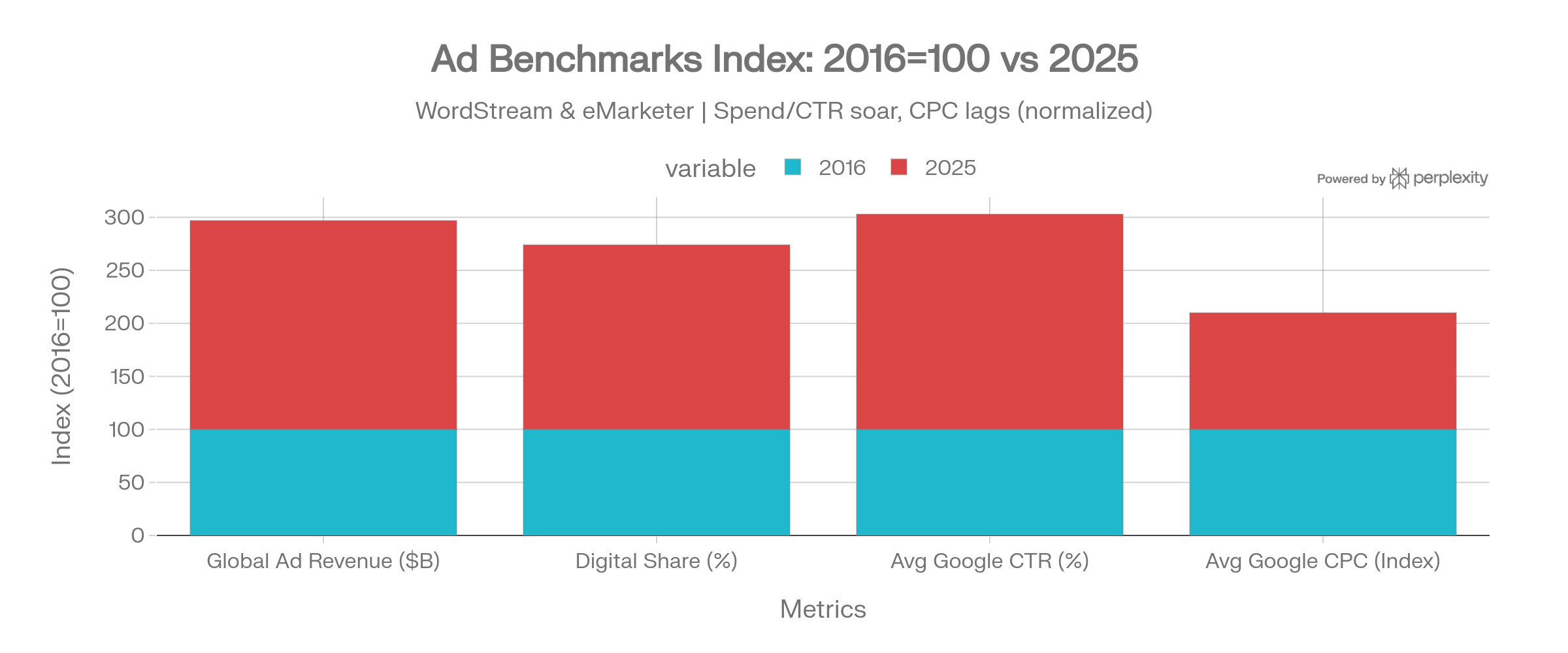
Global ad spend surpassed $1 trillion in 2025, with digital accounting for approximately 73–75% of total spend (eMarketer)
Cost-per-click increased in 86% of industries, with an average increase of ~10% year-over-year (WordStream)
Cost-per-lead rose approximately 25% across 19 of 23 industries, signaling declining acquisition efficiency (WordStream)
Average Google search click-through rates have doubled since 2016, now reaching ~6.4%, yet performance gains have plateaued (WordStream)
Creative quality drives approximately 50% of advertising ROI, making it the single largest performance factor (Nielsen)
Only ~20% of creative assets meet brand quality standards, indicating a significant gap between production and effectiveness (Nielsen)
High-quality creative can improve sales impact by 1.2x to 7.4x, depending on execution (Meta)
Despite more spend, more content, and more access to tools, outcomes are not improving at the same rate.
That gap is not a performance issue. It is a clarity issue.
Marketing has never been more accessible.
And it has never been more ineffective.
There are more tools, more platforms, more data, and more ways to reach customers than ever before.
And yet, for many companies, marketing has never felt less effective.
Global ad revenue hit between $979B and $1.08T in 2025—with digital claiming 73–75% of spend, or $715–777B—but efficiency gains have stalled despite the flood of cash. Customer acquisition costs rose for 86% of industries last year, with average CPC up ~10% YoY even as CTR doubled over the past decade.
Creative performance is declining faster.
Teams are producing more content with less impact.
This is not a temporary shift.
It reflects a structural change in how marketing operates.
Most companies assume they are facing a performance problem.
Others believe the issue is channel mix, execution, or budget.
But these are symptoms, not causes.
This report examines what is actually happening across creative agencies and marketing systems in 2026, and what it means for businesses trying to grow in this environment.
Rising Costs Without Better Outcomes
Marketing investment continues to increase across industries.
Global ad spend surpassed $1T in 2025 for the first time, with digital at ~75% (~$777B), up 8% YoY—yet brands aren’t seeing proportional ROI.
At the same time, cost per click rose in 86% of industries (avg +10% YoY), while CPL climbed ~25% for 19/23 industries—proving more spend just amplifies waste without direction.
Despite this increase in spend, many companies are not seeing proportional improvements in performance.
What this means
Increased investment is not translating into increased efficiency.
Without clear positioning and strong strategic direction, additional spend amplifies inefficiencies rather than resolving them.


More spend does not create better outcomes.


Why Creative Is the New Bottleneck
Content production has accelerated significantly.
Teams are producing more ads, more variations, and more campaigns than ever before.
However, performance cycles are shortening.
Creative fatigue is setting in faster, with ads losing effectiveness in shorter timeframes.
Nielsen finds creative drives ~50% of ad ROI (more than reach or targeting), yet a 1M-ad study showed only ~20% of creatives meet brands’ own quality bars—top creatives cut CPMs 15%. Meta’s data: high-quality creative boosts sales impact 1.2–7.4× short term.
Research from Nielsen shows that creative quality is one of the largest drivers of advertising effectiveness, yet speed of production often comes at the expense of clarity and differentiation.
What this means
The issue is not a lack of creative output.
It is a lack of effective creative direction.
Channels Are Saturated
Paid channels are increasingly competitive.
Search is more crowded.
Social feeds are saturated.
Attention is fragmented across platforms.
Google benchmarks confirm it: CTR up to 6.42% average (doubled since 2016), but CPCs climbed in 86% of industries amid SERP ad dominance and broad match defaults.
As more companies rely on similar acquisition strategies, differentiation becomes more difficult and more expensive.
What this means
Channel strategy alone is no longer a competitive advantage.
The ability to stand out within those channels is.
The Clarity Gap
What is the clarity gap?
The clarity gap is the difference between: what a company believes it communicates and what the market actually understands. It is the space where messaging becomes diluted, positioning becomes unclear, and performance begins to decline.Most companies believe they have a marketing problem.
They do not. They have a clarity problem.
What it looks like in practice
unclear or interchangeable positioninginconsistent messaging across channelsreactive campaign decisionscreative that lacks cohesion or direction
What is actually happening
The foundation is not strong enough to support scale. When positioning is unclear and messaging is inconsistent, every additional marketing effort compounds inefficiency.more ads create more confusionmore spend amplifies weak strategymore content accelerates creative fatigueThis is why performance declines even as investment increases.
What companies assume instead
we need better adswe need more contentwe need to increase spend
Marketing is not becoming less effective. It is becoming less forgiving.
Clear brands scale. Unclear brands spend.
More marketing does not fix unclear thinking. It exposes it.
Why Creative is Breaking
Creative has become the single largest driver of marketing performance.
According to Nielsen, creative quality accounts for approximately 50% of advertising ROI, outweighing targeting, reach, and media mix.
At the same time, the conditions under which creative is produced have fundamentally changed.
Creative performance is not declining because teams are producing less.
It is declining because they are producing without clear direction.
Creative is not failing. Direction is failing.
What’s happening
Content production has increased significantly across all major channels, driven by platform demand for constant iteration (Meta, TikTok, Google)Campaign timelines have shortened, with many teams expected to launch and refresh creative weekly or bi-weeklyDifferentiation is decreasing as brands rely on similar formats, trends, and performance patterns
A large-scale study of over 1 million ads found that only ~20% of creative assets meet brand-defined quality standards, highlighting a significant gap between output and effectiveness (Nielsen).The misconception
Creative is often treated as an output problem:produce more variationstest more formatsincrease volume
The reality
Creative is not an output. It is a reflection of strategic clarity.When direction is unclear, creative becomes:repetitive across campaignsinconsistent across channelsdisconnected from brand positioning
Why the Agency Model is Struggling
The traditional agency model was built for a different marketing environment.
One defined by:
fewer channels
longer campaign cycles
clearer separation between strategy and execution
That environment no longer exists.
Current need
According to Deloitte and McKinsey’s marketing transformation research, companies are increasingly prioritizing:
integrated strategy across channels
faster decision-making cycles
alignment between brand, creative, and performance
systems that scale beyond individual campaigns
Where the gap exists
Many agencies are still structured around production and deliverables, rather than strategic partnership and decision support.
This creates a mismatch between:
what companies need (clarity and alignment)
and what agencies provide (execution and output)
What this means
Hiring an agency does not resolve a lack of clarity. It often makes it more visible.
What High-Performing Companies Do Differently
Observed patterns
Research across McKinsey, Deloitte, and high-growth digital brands shows consistent alignment around a few principles:
clear positioning defined before channel execution
consistent messaging across paid, owned, and earned channels
structured creative systems that allow for iteration without fragmentation
alignment between internal teams and external partners
Companies that are growing efficiently in this environment are not necessarily spending more.They are operating differently.Companies with strong brand clarity and consistency have been shown to outperform competitors in both short-term efficiency and long-term growth (McKinsey, Nielsen)
What they avoid
reactive campaign cycles driven by short-term metrics
excessive content production without strategic direction
fragmented messaging across teams or platforms

Consistency and clarity outperform volume and speed.
What this means for 2026
The companies that succeed in 2026 will not be the ones that produce the most content or spend the most money.
They will be the ones that make the clearest decisions.
Priorities
invest in positioning and strategic clarity before increasing spend
focus on fewer, higher-quality initiatives rather than constant execution
build systems that scale across channels instead of isolated campaigns
align creative, performance, and brand teams around a unified strategy
What to avoid
increasing spend without improving clarity
scaling messaging that is not differentiated
producing content without a defined strategic foundation
The marketing environment is not becoming simpler.It is becoming more complex, more competitive, and less forgiving.
FAQs
What does a creative agency do?
1
A creative agency helps businesses define their brand positioning, develop marketing strategy, and produce creative assets across channels such as paid media, social, web, and content
What services does a creative agency offer?
2
Creative agencies typically offer a combination of:
brand strategy and positioning
messaging and copy development
visual identity and design systems
advertising creative (paid social, search, display)
website design and content
campaign development and execution
The most effective agencies integrate strategy and execution rather than treating them separately.
To choose the right creative agency, evaluate their ability to:
understand your business and market
define clear positioning and messaging
provide strategic direction, not just execution
create work that aligns across channels
demonstrate measurable impact on performance
The best agencies improve decision-making, not just deliver assets.
3
How do you choose the right creative agency?
Marketing costs are increasing due to:
rising competition across digital channels
increased cost-per-click (up ~10% YoY in most industries)
higher cost-per-lead (up ~25% in many sectors)
saturation across search and social platforms
As more companies rely on the same channels, differentiation becomes more difficult and more expensive.
Why is marketing getting more expensive?
4
Why is creative important in marketing performance?
5
Creative is one of the largest drivers of marketing performance.
Research from Nielsen shows that creative quality accounts for approximately 50% of advertising ROI, making it more impactful than targeting or media placement.
Strong creative improves engagement, lowers acquisition costs, and increases conversion rates.
How do you improve marketing performance?
6
Marketing performance improves when businesses focus on:
clear positioning and differentiation
consistent messaging across channels
high-quality creative aligned to strategy
disciplined execution and measurement
Increasing spend alone does not improve performance without clarity.
How much does a creative agency cost?
7
Creative agency pricing varies widely depending on scope, experience, and engagement model.
Typical ranges include:
project-based work: $10,000 to $100,000+
monthly retainers: $5,000 to $50,000+
enterprise engagements: $100,000+
Cost should be evaluated based on business impact, not just deliverables.
A creative agency focuses on brand, messaging, and content development.
A marketing agency typically focuses on channel execution, media buying, and performance optimization.
Many modern agencies combine both, but the distinction matters when evaluating whether you need strategy, execution, or both.
What is the difference between a creative agency and a marketing agency?
8
The decision depends on your stage and internal capabilities.
early-stage companies benefit from external agencies for speed and expertise
growing companies often combine internal teams with agency support
mature organizations may build in-house teams for control and scalability
The most effective model is often a hybrid approach.